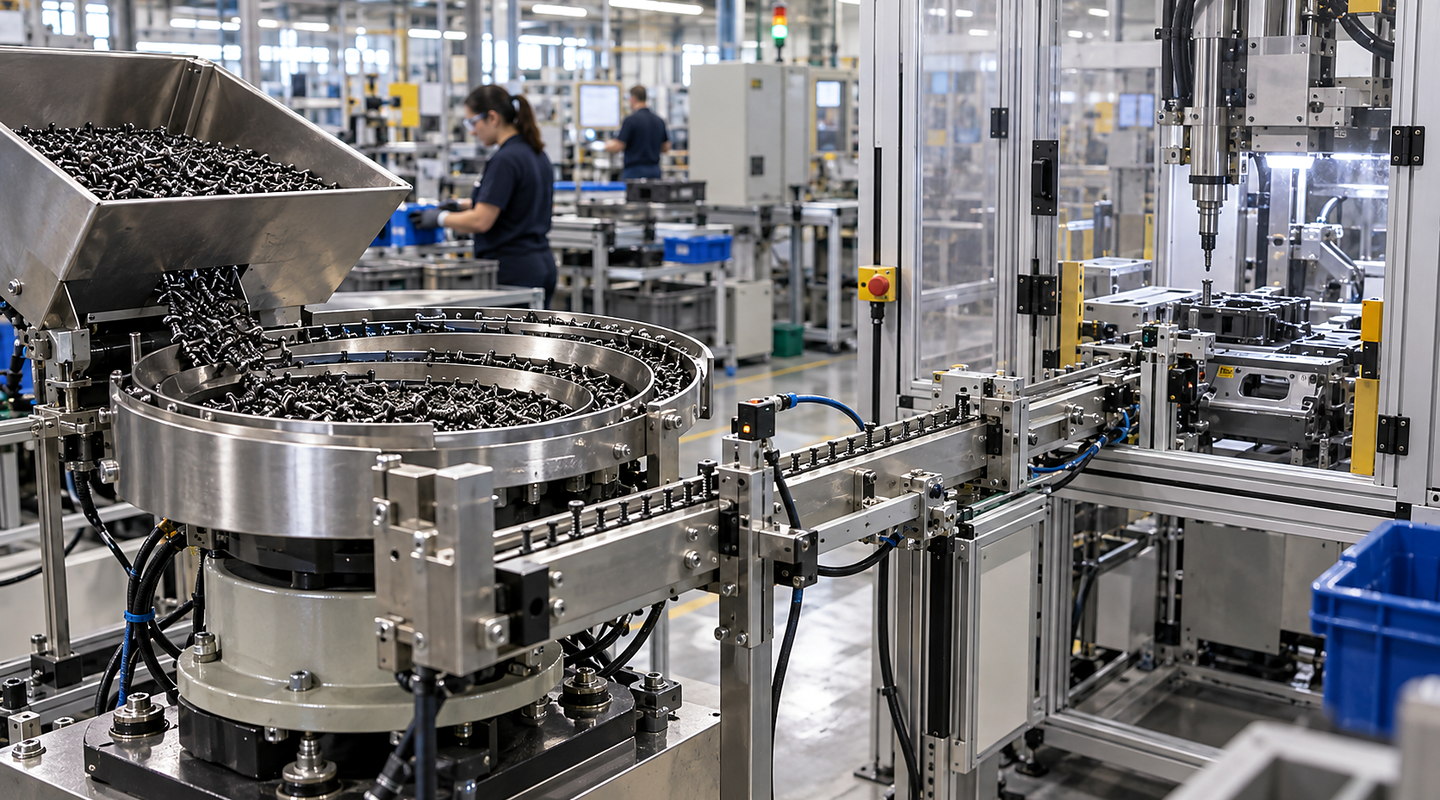
Threaded Insert Feeders Selection Guide
Choose threaded insert feeders by comparing your parts, process, rate, access, data needs and required results.
Select an insert-feeding route by the actual geometry family, separation behaviour, required pose and the receiving tool interface. Compare accepted delivery, surface condition, changeover and recovery under the same conditions. Keep unresolved assumptions in the insert feeder specification rather than treating nominal speed as proof.
For bulk presentation using threaded-insert feeding for assembly, a short trial that reproduces the difficult condition is often more useful than a long list of nominal specifications.
Compare options in the conditions where they must work — Threaded Insert Feeders
Plan threaded insert feeders around real component variation, bulk condition, orientation, usable delivery rate and the downstream interface. Discuss representative part trials with Sorting Solutions. A useful shortlist should show how every option copes with component geometry and variation for threaded-insert feeding for assembly and escapement and downstream pick interface.
Discuss your application
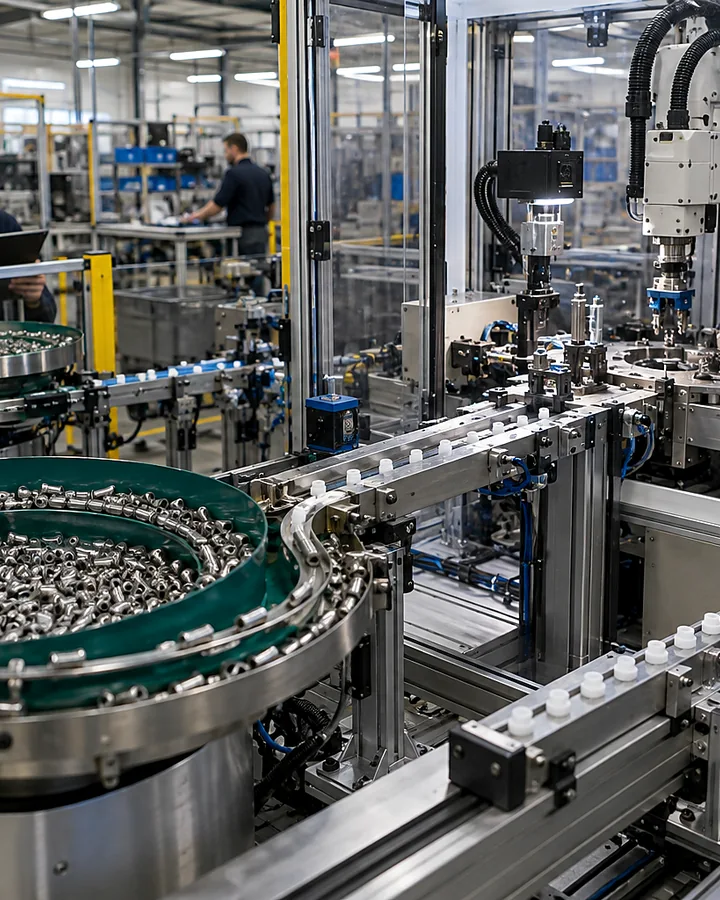
Ask every supplier the same questions
| Decision | What to ask | What to check |
|---|---|---|
| Component Geometry and Variation for Threaded-Insert Feeding for Assembly | Which lengths, threads, flanges, slots or end features distinguish the approved insert references? | A labelled sample set and drawings, including similar variants and the feature used for orientation. |
| Surface, Fragility and Entanglement Behaviour | Where may tooling contact the insert, and can circulation cause damage or parts to nest together? | Condition before and after agreed circulation and transfer, with permitted contact and damage limits recorded. |
| Bulk Condition and Replenishment Method | What bulk condition, fill range and replenishment pattern must the route accommodate? | Representative loose supply and refill observations, including credible bridging or paired parts. |
| Required Orientation and Delivery Rate | Which leading end and rotational position does the receiving tool need, and over what operating pattern? | Correctly oriented inserts accepted by that process; separate feeder movement from usable delivery. |
| Escapement and Downstream Pick Interface | When is the receiver ready, when is it occupied, and how is the insert supported during hand-off? | Agreed demand, release and occupancy states, including an interruption after release. |
| Jam, Damage and Recovery Acceptance Checks | What counts as a jam, damaged insert, wrong presentation or unsuccessful restart? | An assessed trial plan, recovery records, first accepted output and limits on what the evidence proves. |
Include simpler approaches to threaded-insert feeding for assembly in your shortlist
| Approach | Often suitable when | Watch for |
|---|---|---|
| Threaded Insert Feeders | You need a dedicated solution for a clearly defined duty, product or part range and line interface. | Sample trials must include normal, marginal and supplier-variant components. |
| Flexible Vision-Guided Feeding for Suitable Variable Part Families | Your component range includes suitable variable part families that need separation, orientation and presentation trials. | Use representative samples to check separation, orientation, damage and usable delivery at the downstream process. |
| Manual or Tray Presentation where Bulk Feeding Would Damage Parts or Add Unjustified Complexity | Bulk feeding would damage parts or add unjustified complexity for your stated duty. | Check ergonomics, consistency and safe access before choosing the lower-complexity option. |
Pause before choosing when…
- Only perfect or hand-selected examples of bulk presentation using threaded-insert feeding for assembly are available.
- No one has defined how jam, damage and recovery acceptance checks will be evaluated.
- The normal range for component geometry and variation for threaded-insert feeding for assembly is described only as “usually fine” but has not been bounded.
- Your operator, cleaning, maintenance or recovery access has not been considered.
- Quoted performance depends on another machine or data source that is not included.