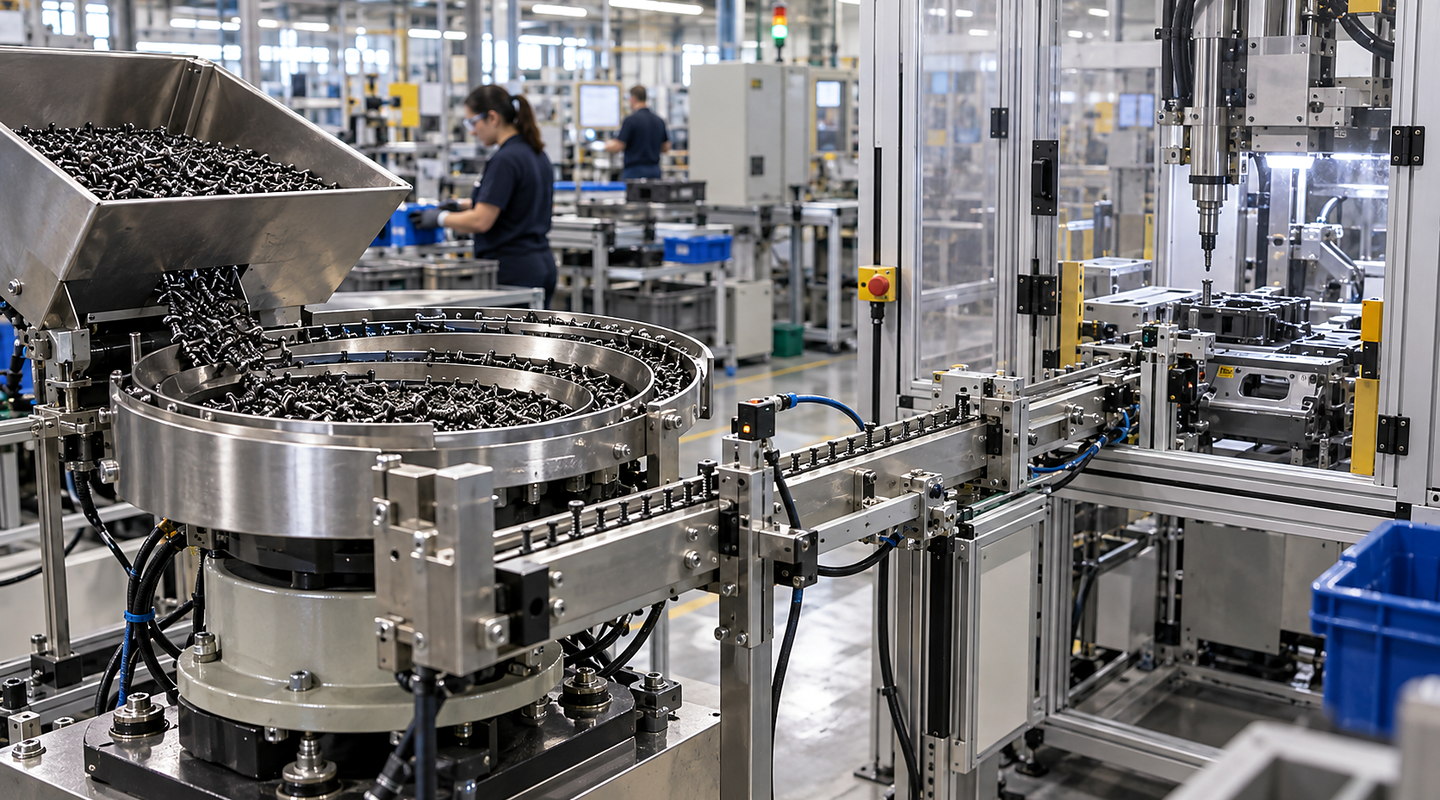
Threaded Insert Feeders: How the Process Works
Follow the operating sequence for threaded insert feeders, from preparing the input and controlling the main task to handling exceptions and checking results.
A threaded-insert feeding sequence separates loose inserts, establishes the required orientation and releases one insert to a ready receiving tool. The project must also define occupied-tool and interrupted-cycle behaviour, protect functional surfaces and prove accepted delivery after replenishment or changeover. Record the result in the rate and recovery checklist.
For your application, the important details include component geometry and variation for threaded-insert feeding for assembly, surface, fragility and entanglement behaviour, bulk condition and replenishment method, and required orientation and delivery rate.
Understand the complete route from input to accepted output — Threaded Insert Feeders
Plan threaded insert feeders around real component variation, bulk condition, orientation, usable delivery rate and the downstream interface. Discuss representative part trials with Sorting Solutions. Follow the material or part through each operating step and include recovery, cleaning and change in the real cycle.
Discuss your application

Four clear stages for threaded insert feeders
At each stage, you can review how component geometry and variation for threaded-insert feeding for assembly and jam, damage and recovery acceptance checks affect the next commitment.
- 01
Review Representative Production Components
Build a labelled reference set covering insert length, thread and external features. Mark the required leading end, permitted support and unacceptable damage, and provide the receiving tool details rather than a nominal insert alone.
- 02
Trial Separation, Orientation and Presentation
Observe separation, orientation and single-part release with the supplied bulk condition and agreed fill range. Include credible nesting or paired parts and inspect threads and other functional surfaces after circulation.
- 03
Develop Tooling, Controls and the Downstream Interface
Define the hand-off position and support until the receiving tool takes control. Agree demand, ready, occupied and cycle-complete states where needed, together with the response if insertion stops after release.
- 04
Challenge Delivery, Replenishment, Jams and Recovery
Record accepted delivery through replenishment, approved variant changes and assessed recovery cases. Account for inserts remaining in tracks, transfer routes and the receiver, and retain the tooling and setting revisions with the results.
Decisions and results stay connected
| Stage | What happens | What you can review |
|---|---|---|
| Review Representative Production Components | Define the labelled insert family, permitted contact and required leading end. | Drawings, representative samples, variant distinctions and receiving-tool acceptance criteria. |
| Trial Separation, Orientation and Presentation | Trial loose-part separation, orientation and release under the agreed bulk conditions. | Observations of nesting, paired parts, functional-surface condition and correctly presented output. |
| Develop Tooling, Controls and the Downstream Interface | Resolve release position, transfer support and the receiver demand and occupancy sequence. | An agreed interface schedule showing who confirms each state and what happens after an interruption. |
| Challenge Delivery, Replenishment, Jams and Recovery | Review replenishment, changeover and assessed exception recovery against accepted delivery. | Trial results, residual-part checks, first accepted restart and any unproven conditions or corrective actions. |
Keep connected responsibilities clear
Your final threaded insert feeders scope must also account for escapement and downstream pick interface, jam, damage and recovery acceptance checks, current regulations and the conditions at your site.
- Sample trials must include normal, marginal and supplier-variant components.
- Quoted feeder output is not the same as usable delivery at the downstream process.
- Fragile, flexible, magnetic or entangling parts may need a different presentation method.